Residential Maintenance • 5 minutes
Do UV Lights and Air Purifiers Actually Work in Florida Homes?
By Scott Camire, Owner | A/C Advantage Inc. •
Fall on the Treasure Coast brings cooler mornings, fewer afternoon storms, and for many people, allergy trouble. It's also when homeowners start asking me about indoor air quality products: UV lights, whole-home purifiers, better filters, and so on.
Some of these products are worth the money. Some are oversold. After nearly five decades in this business, here's my honest take on what works in a humid Florida home.
Start With the Basics: What's in Florida Indoor Air?
Florida homes deal with a specific mix of indoor air problems:
- • Humidity and mold. Our biggest issue. Moisture on the indoor coil, in the drain pan, and in ductwork creates the right conditions for mold and bacteria growth.
- • Pollen. Florida has pollen of some kind for much of the year, including grass and ragweed in the fall.
- • Dust and pet dander. Homes are closed up and running AC most of the year, so the same air recirculates constantly.
- • Odors and household chemicals from cooking, cleaning products, and new furniture.
No single product fixes all of these. The right solution depends on which problem you're trying to solve.
UV Lights: Good at One Specific Job
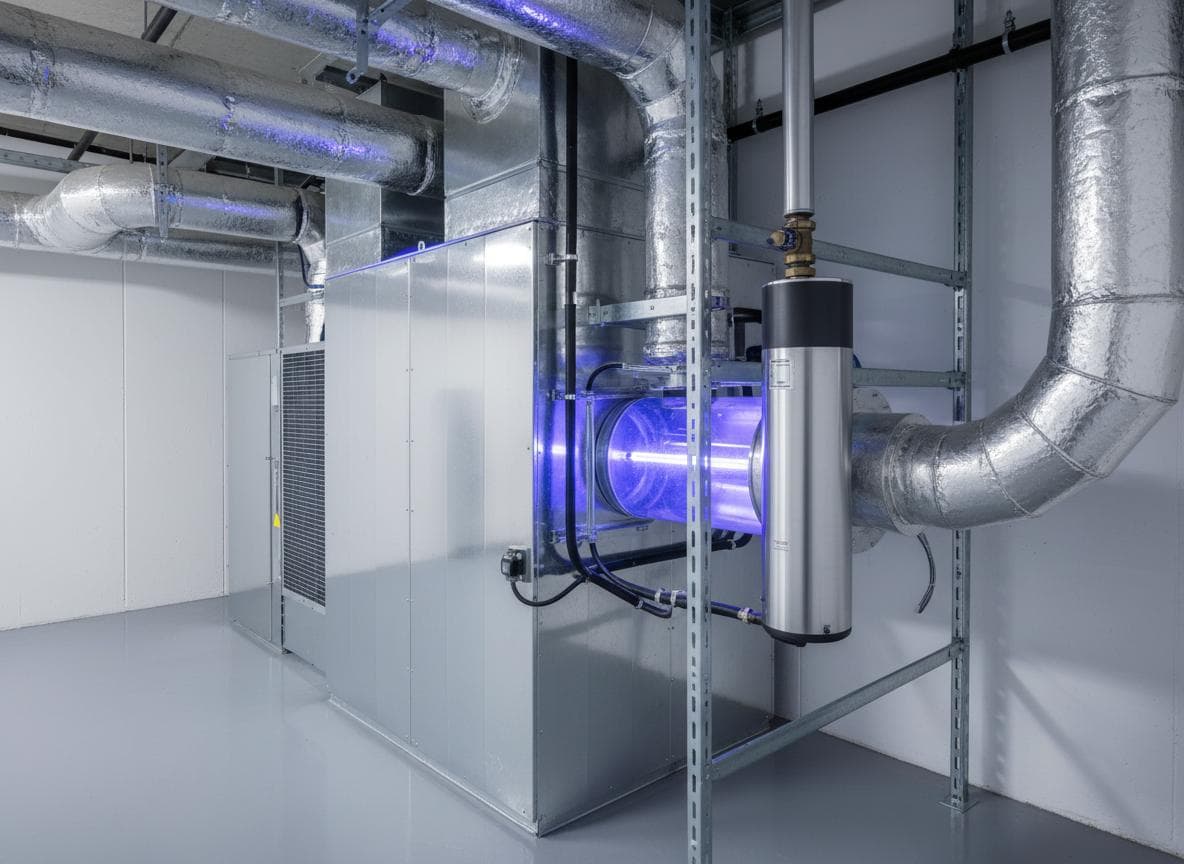
A UV-C light installed inside the air handler shines on the evaporator coil and drain pan. Its main strength is keeping those wet surfaces cleaner by limiting mold and bacteria growth where the light reaches.
Where UV lights help:
- • Homes with recurring musty odors from the AC
- • Systems where the coil tends to grow biological buildup
- • Helping maintain coil cleanliness and airflow between service visits
Where they're oversold:
- • A coil-mounted UV light mainly treats the surfaces it shines on. It is not a guarantee that every germ in the air moving past it is killed.
- • It doesn't remove dust, pollen, or pet dander.
- • UV bulbs lose strength and need replacement on the manufacturer's schedule.
My take: In a humid climate, a coil UV light can be a reasonable investment for homes with moisture-related odor or mold issues. Just understand it's mainly a coil-cleanliness tool.
Filtration: The Most Underrated Upgrade
For dust, pollen, and dander, the filter does most of the work.
- • MERV ratings measure how well a filter captures particles. Higher MERV filters capture more fine particles.
- • Don't just grab the highest number at the store. A very restrictive filter in a system not designed for it can reduce airflow, hurt efficiency, and in some cases contribute to coil freezing.
- • Media filter cabinets, which hold thicker filters, can deliver better filtration with less airflow restriction than a thin high-MERV filter.
My take: For allergy sufferers, a properly sized media filter is often the most cost-effective improvement. Ask your technician what your system can handle.
Whole-Home Air Purifiers
"Air purifier" covers a wide range of technology: advanced filtration, ionization, photocatalytic systems, and more. Performance varies a lot from product to product.
Before buying, ask:
- • What does this product actually remove or reduce: particles, odors, or microbes?
- • Is there independent testing behind the claims?
- • Does it produce ozone? Avoid products that generate ozone as a byproduct.
- • What ongoing maintenance does it require, and what does that cost?
My take: Be skeptical of any product that claims to eliminate everything. A good contractor will match the product to your actual problem.
The Florida Factor Nobody Talks About: Humidity Control
Here's the part many air quality sales pitches skip. If your indoor humidity is too high, no filter or light will fully solve your air quality problems. Mold and dust mites both thrive in humid air.
Keeping indoor humidity roughly between 40 and 60 percent is one of the most effective things you can do for air quality in Florida. That can mean:
- • Making sure your AC is properly sized
- • Running a variable-speed or two-stage system that runs longer at lower speeds
- • Adding a whole-home dehumidifier in some homes
- • Fixing duct leaks that pull in humid attic air
Keep the System Clean
The simplest air quality upgrade costs almost nothing: regular maintenance. A clean coil, clear drain, fresh filter, and clean blower wheel do more for your indoor air than most homeowners realize.
Frequently Asked Questions
Is a UV light for an AC unit worth it in Florida?
It can be, especially in homes with musty AC odors or recurring biological growth on the coil. A coil-mounted UV light mainly keeps the coil and drain pan cleaner. It won't remove dust, pollen, or pet dander, and bulbs need periodic replacement.
What is the best air filter for allergies in Florida?
For many homes, a quality pleated or media filter in the MERV 8 to 13 range offers a good balance of filtration and airflow. The right choice depends on your system's design, so ask your HVAC technician before upgrading.
Do whole-home air purifiers remove mold?
Some products can help reduce airborne mold spores, but no purifier fixes the source. Mold problems in Florida are usually driven by moisture, so humidity control and fixing leaks come first.
What indoor humidity level is best for a Florida home?
Most experts recommend keeping indoor humidity between about 40 and 60 percent. In Florida, many homeowners aim for 50 to 55 percent to limit mold and dust mites.
About the author
Scott Camire, Owner of A/C Advantage Inc.
Scott Camire is the founder of A/C Advantage Inc. in Port St. Lucie, Florida. He began his career in HVAC and commercial refrigeration in 1978 and founded A/C Advantage in 2006, building the company on what he calls “old fashioned service with modern technology.” A/C Advantage is a Florida Certified Mechanical Contractor (License #CMC1249807) with EPA-certified technicians, serving homes and businesses across the Treasure Coast and the Palm Beaches, including Port St. Lucie, Stuart, Palm City, Jensen Beach, Fort Pierce, Vero Beach, Sebastian, and Tradition.
Need help with your system?
Call A/C Advantage at (772) 336-7366. A live person answers 24 hours a day, 365 days a year. Or schedule service online.