Residential Maintenance • 7 minutes
Salt Air and Your Outdoor AC Unit: What Treasure Coast Property Owners Should Know
By Scott Camire, Owner | A/C Advantage Inc. •
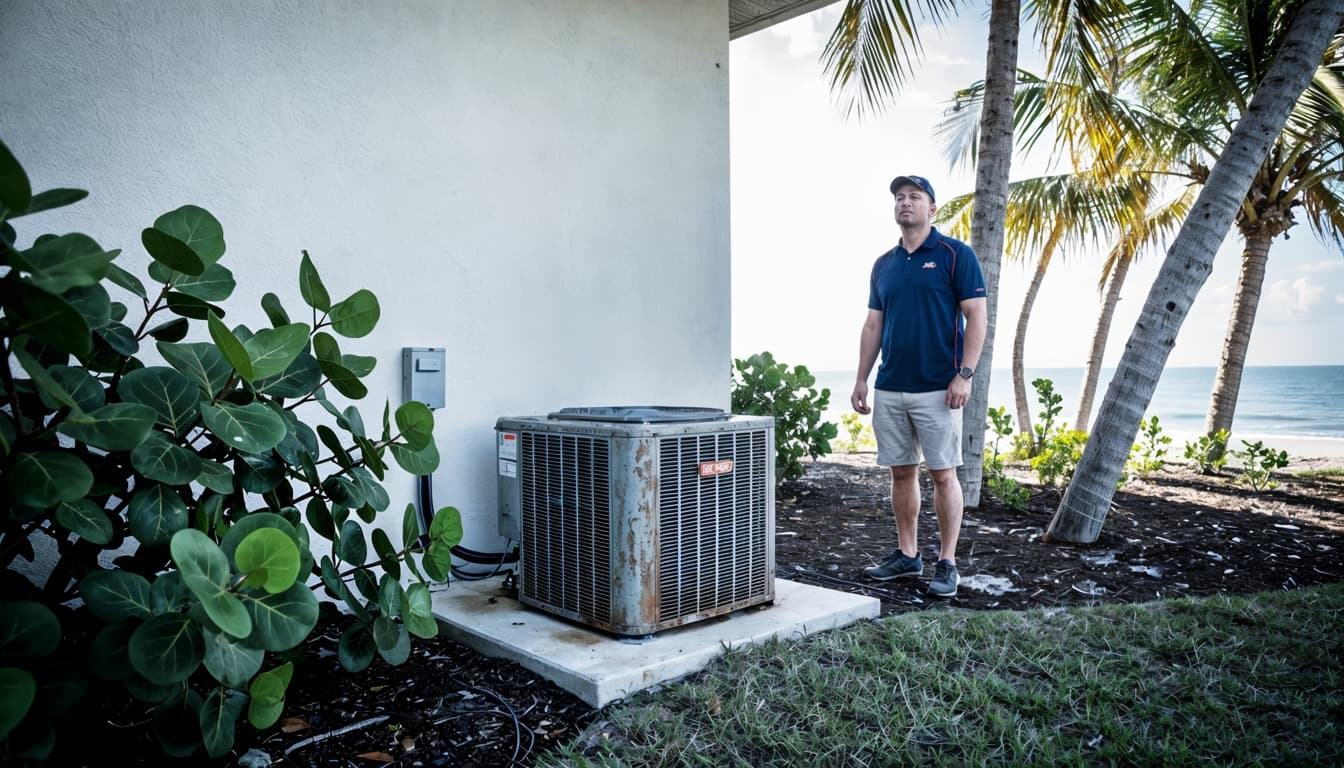
Treasure Coast property owners live with conditions that are easy to enjoy and hard on outdoor equipment: heat, humidity, rain, strong sun, windblown debris, and salt in the coastal air. Your outdoor AC unit is designed for exterior service, but that does not mean it is unaffected by its environment. Salt-laden moisture can contribute to corrosion on metal surfaces and connections over time, particularly where coastal exposure, irrigation overspray, poor drainage, and long operating hours combine.
The practical question is not whether every unit near the water will fail early. There is no responsible universal timeline for that. The question is whether your specific system is being inspected often enough to catch deterioration before it becomes a no-cooling call, electrical concern, or expensive surprise.
What salt exposure can affect
The outdoor condenser contains a coil, fan assembly, cabinet, electrical components, refrigerant connections, and supports. Salt residue and moisture can contribute to corrosion on exposed metal components. The coil’s thin fins are especially important because they transfer heat from the system to the outside air. When airflow or heat transfer is compromised, the system has to work harder to cool the building.
Corrosion does not always mean immediate failure. Some cosmetic aging is visible long before operation changes. Other concerns may be hidden inside a cabinet or at an electrical connection and require a trained technician to evaluate safely. That is why it is worth treating visible rust, flaking coating, loose cabinet hardware, noisy operation, or declining cooling performance as information to report—not as proof of one particular failed part.
Salt is not the only factor. Lawn clippings, mulch, leaves, a crowded landscape bed, roof runoff, and sprinklers that spray the unit can all make outdoor conditions worse. A property farther inland can still have corrosion concerns, while a well-maintained coastal installation can perform reliably. Location matters, but maintenance and installation details matter too.
What you can do safely as an owner
Keep the area around the condenser clear. Remove loose yard debris and stored items from around the unit, and keep plants from growing tightly against it. Make sure routine landscaping does not blow clippings into the cabinet. If irrigation hits the unit directly, have the irrigation pattern adjusted by the appropriate professional rather than allowing constant overspray.
Look at the equipment from the outside during a normal property walk. Note standing water near the pad, a cabinet that seems loose or shifted, visible corrosion, damaged protective grilles, branches touching the unit, or new vibration and noise. Photograph visible conditions if it is safe. This creates a helpful record for a maintenance visit.
Do not use a pressure washer, strong chemical cleaner, abrasive tool, or improvised coating on the unit. High pressure can bend fins and force water where it should not go. Harsh chemicals can damage materials or create runoff concerns. Do not remove the electrical panel, touch wiring, straighten fins, or attempt a refrigerant repair. Coastal AC care is not a reason to take electrical or refrigeration risks.
Maintenance is how you get a real answer
A professional maintenance visit gives the technician a chance to inspect the system’s overall operating condition, coils, visible corrosion, electrical components, drainage, refrigerant performance, mounting condition, and airflow. What is appropriate for a particular unit depends on its make, age, condition, installation, and exposure. The technician can also point out when a repair is reasonable and when accumulating issues deserve a replacement discussion.
Ask for clear notes. If corrosion is present, where is it? Is it cosmetic, something to monitor, or affecting operation now? Are there related concerns such as a weak capacitor, deteriorated wiring insulation, a damaged coil, or a drainage issue? Good records make it easier to see whether a condition is stable or progressing.
For commercial sites, include rooftop and ground-level condensers in the maintenance inventory. Roof access, unit securement, electrical work, and coil service should be performed by qualified personnel with the correct safety procedures. Managers can help by documenting which spaces each unit serves and reporting repeat comfort complaints early. Our Commercial Rooftop HVAC Guide is a useful companion for commercial property planning.
Watch for signs that should not wait
Call for professional AC service if the system is not cooling normally, runs with a new harsh noise, repeatedly trips a breaker, has a burning odor, shows visible ice, or has obvious physical damage. Also call if a coastal unit has corrosion around electrical areas, loose panels, or a shifted pad. Turn the system off at the thermostat if you see ice or hear damaging mechanical noise, and do not keep restarting it in hopes it will recover.
For a Treasure Coast home, condo, rental, or commercial property, A/C Advantage can provide an on-site evaluation and maintenance service focused on the equipment you actually have. Contact us to schedule a coastal AC inspection, discuss visible corrosion, or diagnose a cooling concern. Salt air is part of living here; a planned maintenance approach is how you keep it from becoming the only explanation offered after a preventable breakdown.
Related hub: How Often Should You Service Your AC in Florida?
About the author
Scott Camire, Owner of A/C Advantage Inc.
Scott Camire is the founder of A/C Advantage Inc. in Port St. Lucie, Florida. He began his career in HVAC and commercial refrigeration in 1978 and founded A/C Advantage in 2006, building the company on what he calls “old fashioned service with modern technology.” A/C Advantage is a Florida Certified Mechanical Contractor (License #CMC1249807) with EPA-certified technicians, serving homes and businesses across the Treasure Coast and the Palm Beaches, including Port St. Lucie, Stuart, Palm City, Jensen Beach, Fort Pierce, Vero Beach, Sebastian, and Tradition.
Need help with your system?
Call A/C Advantage at (772) 336-7366. A live person answers 24 hours a day, 365 days a year. Or schedule service online.