Commercial HVAC • 7 minutes
Why Is Water Coming From a Commercial Rooftop Unit? What Property Managers Should Do
By Scott Camire, Owner | A/C Advantage Inc. •
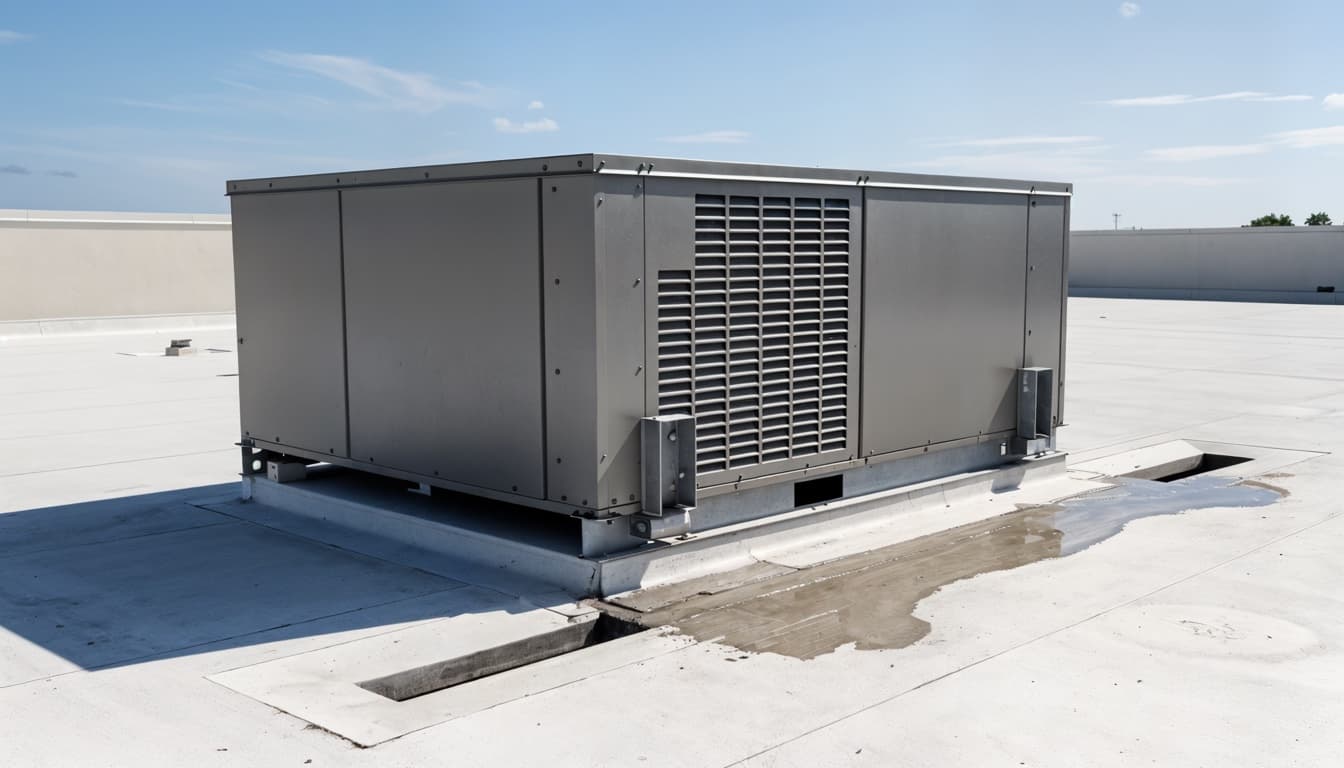
Water around a commercial rooftop unit is not always an HVAC failure. Florida rain, roof drainage, condensate, curb flashing, plumbing, and equipment operation can all put water on a roof. But water that appears in a ceiling, mechanical room, tenant space, or electrical area needs prompt attention. The first priority is to protect people and property while identifying the source correctly.
Do not assume every puddle near a rooftop unit is “just condensation,” and do not assume every ceiling leak came through the unit. A careful investigation saves time, avoids repeated repairs, and helps preserve the roof warranty and equipment condition.
Start With Safety and Building Impact
If water is entering an occupied space, approaching electrical equipment, causing ceiling tiles to sag, or creating a slip hazard, secure the area and follow the property’s emergency procedures. Turn off the affected HVAC unit only if it can be done safely and according to site procedures. Coordinate with building maintenance, roof personnel, and an HVAC professional as needed.
Keep people off the roof during lightning, high winds, unsafe wet conditions, or when access requirements are not met. Rooftop equipment should be assessed by trained personnel with proper access and fall-protection procedures. Property staff should not climb onto equipment, open electrical panels, or attempt refrigerant repairs.
Document the time, weather, affected area, unit location, and whether the system was running. Photos of visible water paths, ceiling staining, roof drains, and the unit tag can be useful if taken safely. Those facts help distinguish a rain-related event from a condensate or equipment issue.
Common Sources of Water Near Rooftop Equipment
A condensate pan or drain problem is one possibility. In cooling mode, an HVAC unit removes moisture from the air and sends condensate to a designed drain path. A blocked drain, damaged pan, poor trap arrangement, or line issue can cause overflow. The report should confirm where water is coming from rather than merely clearing a line and leaving the rest unexplained.
Rainwater can enter through damaged cabinet panels, door gaskets, pipe penetrations, curb flashing, roof seams, or an improperly sealed opening. Roof drainage may also pond around equipment because a drain is blocked or the roof surface is not shedding water as intended. That is a roofing or drainage concern that may exist beside, rather than inside, the HVAC unit.
A frozen evaporator coil can eventually create water when it thaws. Low airflow, dirty filters, blower problems, controls, or refrigerant-related conditions can contribute to icing. The cause needs professional diagnosis; simply restarting the unit can repeat the damage.
In some cases, a plumbing leak, irrigation, or another rooftop system is the source. This is why tracing the path matters. Water can travel along framing, pipes, or roof surfaces and show up far from where it began.
What a Good Investigation Includes
An HVAC technician should identify the equipment, observe its operating condition, inspect accessible condensate components, and look for signs of coil icing, airflow restriction, cabinet damage, and visible water paths. They may document filters, drains, pans, coils, controls, and the condition of surrounding components.
A roofing professional may need to inspect the roof membrane, seams, curb, penetrations, flashing, drainage, and ponding. Coordination matters: an HVAC repair does not repair a roof seam, and a roof patch does not correct a blocked condensate line. A clear report should say which party needs to address each condition.
Ask for photos and a written description of the observed source, completed work, remaining risks, and follow-up recommendations. Our article on commercial HVAC maintenance reports explains what a useful record should include.
Avoid These Common Mistakes
Do not keep operating a unit that is actively leaking into the building or showing electrical concerns. Do not send untrained staff onto a wet roof to “check the drain.” Do not puncture, bypass, or remove safety components to get cooling back quickly. And do not treat recurring water as a housekeeping issue. Repeated overflow can damage insulation, ceiling systems, finishes, and equipment while creating tenant disruption.
Also avoid assuming a recently cleaned drain has solved every future problem. If water returns, review drain slope, trap details, pan condition, equipment level, coil condition, and the building’s roof-water path. Trends are important, especially for units with recurring service notes.
Build Water Checks Into Maintenance
A commercial maintenance visit should include visible drain and pan condition, filter condition, coil cleanliness, cabinet condition, and operational observations appropriate to the equipment. The service record should identify the unit and note deficiencies by priority. Read our Commercial Rooftop HVAC Guide for a broader approach to rooftop planning and maintenance.
A/C Advantage can inspect commercial rooftop HVAC equipment, document the condition, and communicate where HVAC work ends and roof or building work may begin. If water is entering the building, treat it as a property-protection issue, secure the area, and get the source identified before a small leak becomes a larger interruption.
Keep the completed report with roof and service records, including the weather at the time of the event. That documentation helps a manager recognize repeat locations and coordinate the right follow-up.
About the author
Scott Camire, Owner of A/C Advantage Inc.
Scott Camire is the founder of A/C Advantage Inc. in Port St. Lucie, Florida. He began his career in HVAC and commercial refrigeration in 1978 and founded A/C Advantage in 2006, building the company on what he calls “old fashioned service with modern technology.” A/C Advantage is a Florida Certified Mechanical Contractor (License #CMC1249807) with EPA-certified technicians, serving homes and businesses across the Treasure Coast and the Palm Beaches, including Port St. Lucie, Stuart, Palm City, Jensen Beach, Fort Pierce, Vero Beach, Sebastian, and Tradition.
Need help with your system?
Call A/C Advantage at (772) 336-7366. A live person answers 24 hours a day, 365 days a year. Or schedule service online.