
Residential Maintenance • 7 minutes
Best Thermostat Settings for Florida Summer Comfort, Humidity, and Energy Use
By Scott Camire, Owner | A/C Advantage Inc. •
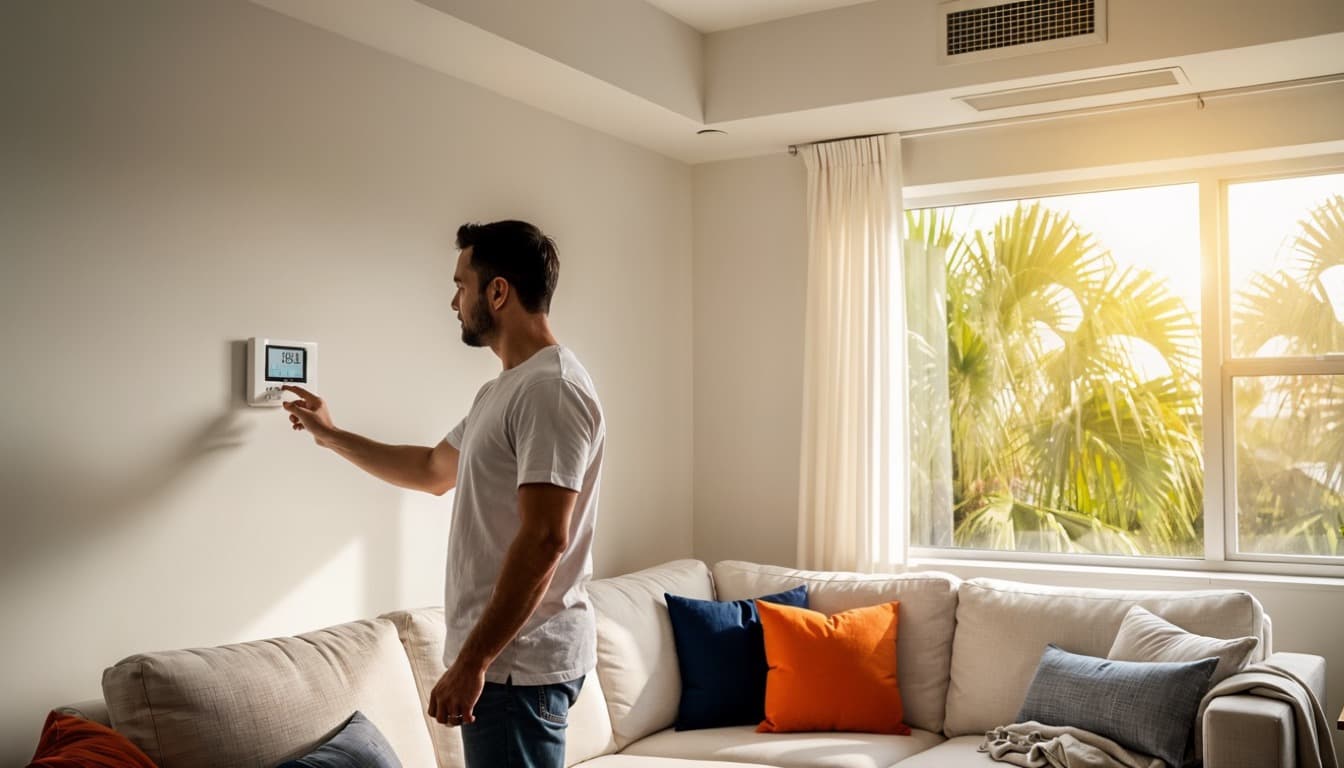
There is no single “right” thermostat number for every Florida home. A family’s comfort, schedule, insulation, windows, ductwork, and humidity all matter. Still, a steady, realistic setting is usually better than chasing comfort by making large changes all day.
For many occupied homes, a setting in the mid-70s is a sensible starting point. If 75 or 76 feels comfortable, there is little reason to force the system toward a much colder setting. If it does not feel comfortable, the answer may not be a lower number. It may be humidity, airflow, a hot room, solar gain, or a maintenance issue.
Temperature Is Only Half the Florida Story
Florida air carries moisture. Your AC removes some humidity while it runs, which is why a home can feel sticky even when the thermostat shows a temperature that normally feels fine. Lowering the setpoint may make the equipment run longer, but it is not a reliable cure for an underlying humidity or airflow problem.
Start with a stable setting for a few days. Notice whether the system cycles normally, whether rooms are even, and whether the air feels damp. If the home feels clammy, has a musty odor, or has moisture around the indoor unit, schedule professional service rather than repeatedly changing the thermostat. Drainage, coil condition, duct leakage, equipment sizing, and controls can all affect comfort.
A Practical Daily Strategy
Choose a comfortable occupied setting and avoid large swings. When you leave for work or travel for a short period, raising the temperature modestly is usually more practical than turning the system off. An empty Florida house can accumulate heat and humidity. The exact setback depends on the home and household, but a small adjustment is easier on comfort recovery than an extreme one.
When you return, set the thermostat back to your normal comfort setting and give the system time to work. Setting it dramatically lower does not make the house cool faster; it simply tells the system to run longer. If the house repeatedly cannot recover, that is useful diagnostic information for a technician.
For sleep, some people prefer a slightly cooler bedroom setting. Use it if it works for your family, but recognize that the whole-home system still has to serve the thermostat location. A ceiling fan can improve how occupants feel at a given room temperature. Turn fans off in empty rooms because they cool people, not the space itself.
Smart Thermostats Help Only When Set Up Well
A programmable or smart thermostat can make a household schedule easier to manage. It can also create frustration if schedules, sensors, or settings fight the way the home actually behaves. Before buying or programming one, make sure the thermostat is compatible with the system and installed in a representative location away from direct sun, supply vents, cooking heat, and exterior doors.
Use schedules conservatively at first. A sudden daily jump from very warm to very cool can create long recovery periods. Review the actual indoor comfort, not just the app. If a remote sensor is used, make sure it is placed where it answers a real problem, such as a frequently occupied bedroom—not hidden behind furniture or in direct sunlight.
Reduce the Load Before Lowering the Setting
Thermostat comfort improves when the home has less heat to fight. Close blinds or shades on sun-facing windows, seal obvious gaps around doors, keep return grilles unobstructed, and make sure supply vents are open unless a technician has recommended otherwise. Do not close numerous vents in an attempt to push all cooling into one room; that can disrupt airflow and may create other problems.
Check the filter regularly. A loaded filter restricts airflow and can make a system run longer with less comfort. Use the correct filter size, fit it properly, and follow the manufacturer’s replacement guidance. Keep foliage and debris away from the outdoor unit. Beyond those basic tasks, leave electrical, refrigerant, and internal equipment work to qualified technicians.
When the Setting Is Not the Problem
If one room stays hot, the house feels humid at normal temperatures, bills jump without a weather explanation, or the system runs nearly constantly, a thermostat change is not the full answer. Review how AC sizing affects humidity and our Florida AC maintenance guide for the issues worth checking.
A/C Advantage can evaluate airflow, drainage, equipment condition, thermostat operation, and comfort complaints. The best thermostat setting is the one that keeps your household comfortable without masking a system problem. Start steady, observe the results, and call for help when the home is telling you something more needs attention.
Before a service visit, write down a typical day: when the home begins to feel uncomfortable, how long the system runs, whether humidity is noticeable, and which rooms differ. Include recent filter changes and any water, odor, or noise you have noticed. That simple record gives the technician a better starting point than a thermostat number alone. It also helps distinguish a scheduling adjustment from an equipment or airflow concern that needs a timely qualified professional repair.
If someone in the household works from home, cares for a child, or spends most of the day in one room, note that too. Occupancy patterns explain why a setting that works overnight may not feel right during the afternoon. A useful comfort plan starts with how the home is actually used, not a number copied from someone else’s thermostat.
About the author
Scott Camire, Owner of A/C Advantage Inc.
Scott Camire is the founder of A/C Advantage Inc. in Port St. Lucie, Florida. He began his career in HVAC and commercial refrigeration in 1978 and founded A/C Advantage in 2006, building the company on what he calls “old fashioned service with modern technology.” A/C Advantage is a Florida Certified Mechanical Contractor (License #CMC1249807) with EPA-certified technicians, serving homes and businesses across the Treasure Coast and the Palm Beaches, including Port St. Lucie, Stuart, Palm City, Jensen Beach, Fort Pierce, Vero Beach, Sebastian, and Tradition.
Need help with your system?
Call A/C Advantage at (772) 336-7366. A live person answers 24 hours a day, 365 days a year. Or schedule service online.