Residential Repair • 6 minutes
AC Breaker Keeps Tripping: When to Shut the System Down and Call a Professional
By Scott Camire, Owner | A/C Advantage Inc. •
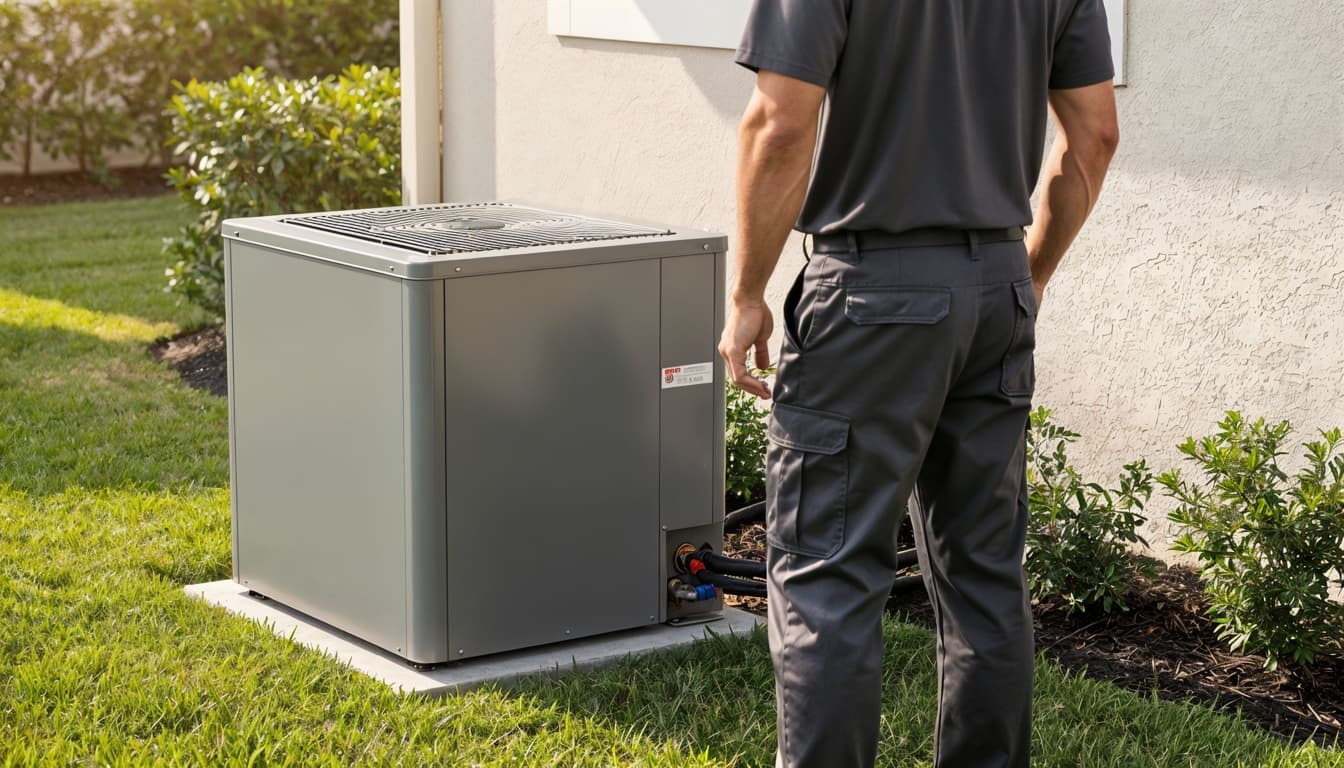
An AC breaker that trips once is worth noting. A breaker that keeps tripping is a reason to stop treating the air conditioner like a normal comfort problem and start treating it like a safety issue. The breaker is designed to interrupt power when it senses a condition it should not ignore. Resetting it repeatedly can send power back to equipment with an unresolved fault and can make a small problem harder to diagnose.
In Florida, an air conditioner may run for long stretches, especially during hot, humid weather. That runtime can expose weaknesses in components, wiring, motors, capacitors, controls, or the electrical circuit. It does not tell you which one is at fault. That is why a repeat trip needs a professional evaluation rather than a sequence of homeowner experiments.
When to shut the system down
If the breaker trips again after a single reset, turn the thermostat system setting to off and leave the system off until it is evaluated. Do not keep cycling the breaker to get through the afternoon. If you notice a burning smell, smoke, buzzing or crackling, visible damage, water around electrical equipment, a hot electrical panel, or a shock sensation, do not touch the equipment or panel. Move people away from the immediate area and contact the appropriate emergency service or a licensed professional.
A storm, water intrusion, or a recent power outage adds another reason to be cautious. Moisture and damaged electrical components are not a DIY inspection project. Do not remove the AC cabinet, open the disconnect, pull covers from the electrical panel, or probe wires. Those actions create real shock and fire risks and can damage equipment further.
If the system must remain off, protect the home in the basic ways you can do safely: close blinds against direct sun, keep doors and windows closed when practical, use fans if power is available, and check on people who may be more sensitive to heat. Those steps do not fix the electrical condition, but they can make the waiting period more manageable.
What a tripping breaker can indicate
The AC is one system made up of several electrical and mechanical parts. A breaker may trip because the equipment is drawing more current than it should, because there is an electrical fault, or because the circuit itself has a problem. A failing compressor, condenser fan motor, indoor blower motor, capacitor, contactor, damaged wiring, a shorted component, or a problem in the branch circuit can all be part of the investigation. An overloaded circuit or a problem at the panel may require an electrician in addition to HVAC service.
It is tempting to assign the cause from a sound or a warm room, but symptoms overlap. For example, a unit that hums and trips may have several possible causes; a system that trips during a heavy cooling cycle may have a different issue than one that trips immediately. A technician needs to inspect the equipment and electrical side safely, test components, and determine whether the problem is in the AC equipment or elsewhere in the circuit.
A dirty filter or a blocked return can strain an AC system, but do not assume a filter change explains repeated breaker trips. You can replace a normal homeowner-accessible filter only if it can be done safely and the system is off, following the equipment instructions. Do not use that as a reason to reset a breaker over and over. The repeat trip is the important fact to report.
Useful details to give the technician
A clear description can speed up a safe diagnosis. Write down when the breaker tripped, whether the AC had just started or had been running, whether the indoor blower was operating, what the thermostat was set to, and whether you heard any unusual sounds. Note recent service, a power outage, work near the outdoor unit, standing water, or a storm. If the breaker has a label, share the label rather than trying to identify wiring yourself.
Also tell the technician how many times the breaker has tripped and whether it tripped immediately after being reset. That sequence helps distinguish a persistent fault from a condition that occurred after a specific event. Avoid taking photos inside a panel or opening any electrical enclosure for more information. A simple description from a safe distance is enough for scheduling.
Prevention is not the same as a repair
Regular AC maintenance helps identify loose connections, worn components, drainage issues, airflow restrictions, and equipment wear before peak demand makes a failure urgent. It cannot guarantee that a breaker will never trip, but it gives a qualified technician a chance to inspect the system under controlled conditions. Florida homes benefit from an approach that includes both cooling performance and electrical safety, not just a quick response after the house turns warm.
If your breaker has tripped repeatedly, do not wait for the next maintenance visit. Leave the system off and call for help. A/C Advantage can evaluate AC equipment and advise when an electrical contractor is needed. For broader repair guidance, visit AC Repair or review How Often Should You Service Your AC in Florida?.
The next right step is simple: stop repeated resets, document what happened, and contact A/C Advantage for a professional assessment. Electrical safety is not the place to troubleshoot by trial and error.
About the author
Scott Camire, Owner of A/C Advantage Inc.
Scott Camire is the founder of A/C Advantage Inc. in Port St. Lucie, Florida. He began his career in HVAC and commercial refrigeration in 1978 and founded A/C Advantage in 2006, building the company on what he calls “old fashioned service with modern technology.” A/C Advantage is a Florida Certified Mechanical Contractor (License #CMC1249807) with EPA-certified technicians, serving homes and businesses across the Treasure Coast and the Palm Beaches, including Port St. Lucie, Stuart, Palm City, Jensen Beach, Fort Pierce, Vero Beach, Sebastian, and Tradition.
Need help with your system?
Call A/C Advantage at (772) 336-7366. A live person answers 24 hours a day, 365 days a year. Or schedule service online.