Commercial Refrigeration • 7 minutes
Restaurant Refrigeration During a Power Outage: Temperatures, Logs, and Who to Call
By Scott Camire, Owner | A/C Advantage Inc. •
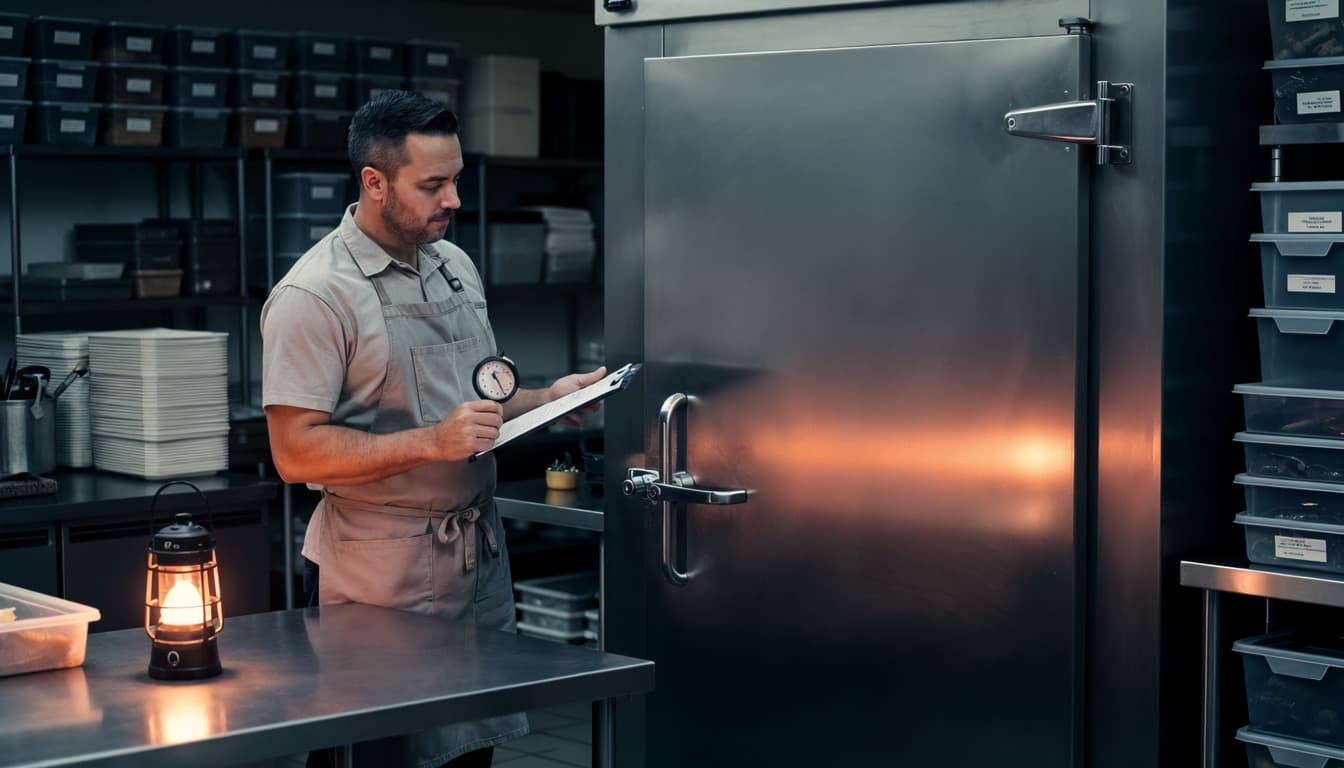
A power outage puts a restaurant manager into two different jobs at once: protect people in the building and preserve enough information to make responsible food decisions afterward. The refrigeration equipment may be perfectly sound, but it cannot cool without power. The most valuable thing a team can do in the first minutes is slow the temperature change, document what is happening, and use the operation’s food-safety plan.
This article is a practical equipment-and-records checklist, not a substitute for your local food-safety authority, insurer, brand requirements, or written emergency plan. Food disposition and compliance decisions belong to the applicable food-safety authorities and your operation’s qualified food-safety leadership. When there is uncertainty, do not guess.
First: confirm the scope and keep doors closed
Determine whether the outage is limited to your restaurant or affects the surrounding area. Notify the manager on duty and begin the outage log immediately. Record the time power was lost or first noticed, who confirmed it, which equipment is affected, and the indoor conditions if they are relevant.
Then keep refrigerator, freezer, walk-in, and ice-machine doors closed as much as possible. Every opening exchanges cold air for warm, humid Florida air. Assign one person to control access rather than allowing multiple employees to check product repeatedly. A quick, organized check is better than a parade of open doors.
Do not move food around without a plan. Moving product can expose it to more warm air and make tracking harder. If you have approved alternate cold storage, a working generator system designed for that load, or a refrigerated truck arrangement, use the procedures already established for your location. Never improvise generator connections or electrical work during an outage.
Build a usable temperature log
A log should help you answer basic questions later: What equipment was affected? When did temperatures begin to rise? Which readings came from which unit? Who took them? Use the calibrated thermometers and logging tools your food-safety program specifies. Note the time of each reading, the unit location, the displayed temperature if available, and any product-temperature measurement your approved procedure calls for.
FDA food-safety guidance commonly emphasizes keeping cold food at 40°F or below and frozen food frozen, but the exact decision about specific food, time, and disposition depends on the product, your verified measurements, and the rules that apply to your operation. Do not use a generic internet chart as permission to keep or discard food. Contact the appropriate food-safety authority or qualified food-safety advisor for compliance and disposition decisions.
For equipment service, also record whether doors remained closed, whether a unit was full or lightly loaded, whether the condenser area was unusually hot, and whether any alarm or error code appeared before power loss. These details do not decide food safety, but they can help identify an equipment issue when power returns.
Know who gets called, and in what order
Keep a printed and digital contact list where the manager can find it without relying on one person’s phone. Include utility outage reporting, landlord or property management, your electrician, generator provider if applicable, refrigeration service, alarm monitoring, restoration contact, food-safety authority contact, and decision-makers authorized to approve emergency expense.
Call commercial refrigeration service when the power returns and equipment does not restart, a breaker trips repeatedly, a unit will not pull down, an alarm persists, there is water or oil where it should not be, or equipment was physically damaged. If refrigeration was already struggling before the outage, say so. A power interruption can reveal a separate failure that needs diagnosis.
A/C Advantage can evaluate commercial refrigeration equipment after an outage, but we do not make food-disposition or regulatory compliance decisions for your restaurant. That division matters. Our job is to assess the equipment safely and accurately; your food-safety team and authorities guide what happens with the product.
Restart in an organized way
When power is restored, do not treat the event as over. Note the restoration time. Check that equipment is receiving power and allow normal built-in delays to occur. Listen and look from a safe distance for unusual noises, electrical odors, water leaks, or alarms. Do not open electrical panels, reset a tripped breaker over and over, or bypass safety controls.
Continue the temperature log as each unit recovers. Prioritize the equipment and product loads identified in your plan, but avoid opening doors so often that you slow recovery. Check door closures and gaskets visually. If a walk-in or reach-in will not return to normal operation, keep doors closed and call for service rather than hoping it will catch up.
After the immediate event, hold a short review. Was the contact list current? Were thermometers available? Did everyone know who could authorize a generator, product transfer, or service call? A calm correction after an outage is how the next one gets easier.
For Treasure Coast restaurants that want a clearer refrigeration maintenance and response plan, contact A/C Advantage for commercial refrigeration service. We can inspect the equipment your kitchen depends on, document operating concerns, and help you address repair needs before the next interruption. For a broader maintenance perspective, read our Commercial Refrigeration Uptime Guide.
About the author
Scott Camire, Owner of A/C Advantage Inc.
Scott Camire is the founder of A/C Advantage Inc. in Port St. Lucie, Florida. He began his career in HVAC and commercial refrigeration in 1978 and founded A/C Advantage in 2006, building the company on what he calls “old fashioned service with modern technology.” A/C Advantage is a Florida Certified Mechanical Contractor (License #CMC1249807) with EPA-certified technicians, serving homes and businesses across the Treasure Coast and the Palm Beaches, including Port St. Lucie, Stuart, Palm City, Jensen Beach, Fort Pierce, Vero Beach, Sebastian, and Tradition.
Need help with your system?
Call A/C Advantage at (772) 336-7366. A live person answers 24 hours a day, 365 days a year. Or schedule service online.