Commercial Refrigeration • 7 minutes
Ice Machine Warning Signs Restaurant Owners Should Not Ignore Before a Busy Weekend
By Scott Camire, Owner | A/C Advantage Inc. •
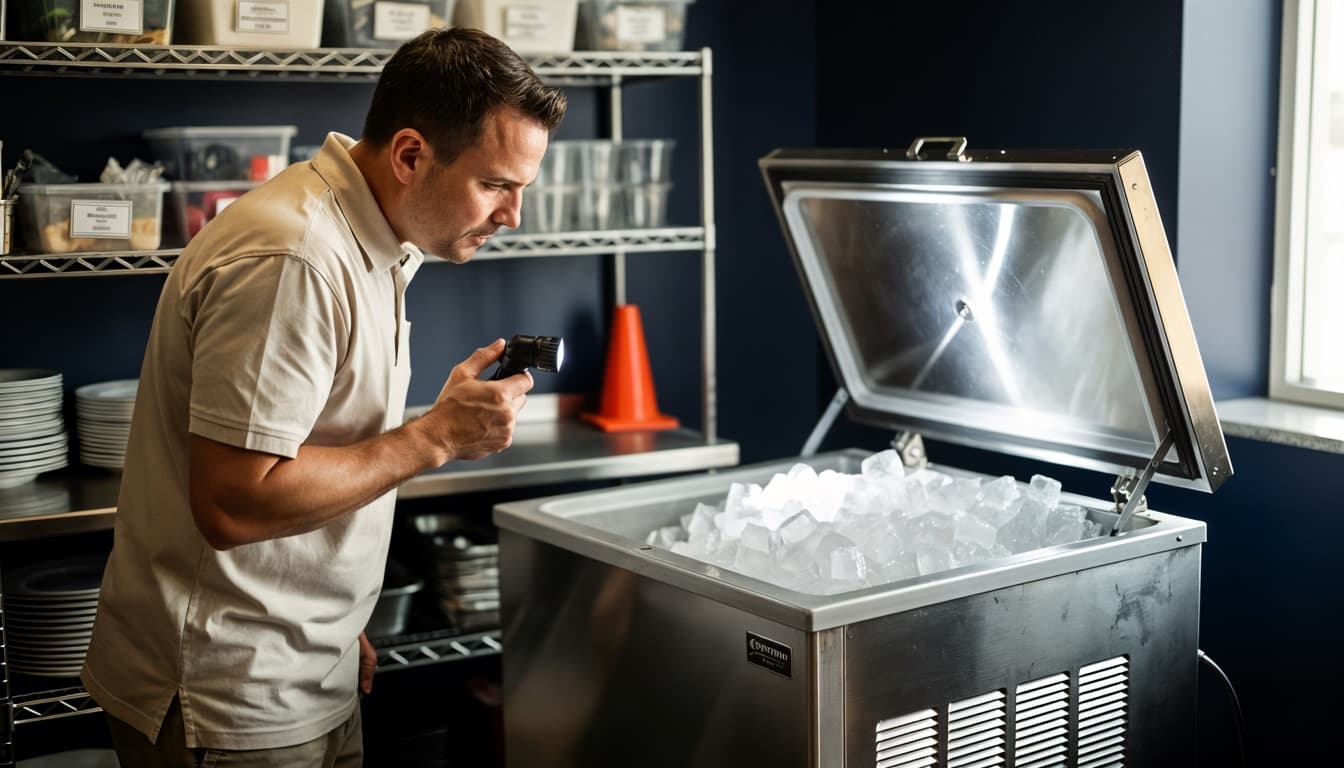
An ice machine can look like a small piece of equipment until a busy Friday exposes how much the operation depends on it. Beverage service, bar stations, prep, display, and customer expectations can all be affected when production drops. The right time to notice a warning sign is before the weekend rush, not after the bin is empty.
I recommend a simple manager walk-through at the end of the week. You are not trying to repair refrigeration equipment or take panels off. You are looking for changes from normal operation and making a clear service call early enough for a technician to diagnose the actual cause.
The bin is not recovering like it normally does
The most useful warning sign is often the one your team already sees: the bin is lower than it should be at a familiar time of day. If the same service volume normally leaves enough ice for lunch prep and now it does not, write that down. A machine may still make some ice while producing too slowly to support the restaurant.
Ask the staff whether the shortage appeared gradually or suddenly. Did a machine that used to keep up now run continuously? Is a second station borrowing ice from the same bin? Has the menu, event schedule, or beverage volume changed? Usage matters, but it does not explain away a clear change in production.
Avoid responding by overfilling the bin with bagged ice and forgetting the underlying problem. Bagged ice may help with immediate service, but a struggling machine still needs attention before it stops completely.
Ice quality is a maintenance clue
Look at the ice itself. Changes in cube shape, size, clarity, or hardness can be useful clues for the service technician. So can unusual amounts of broken ice, soft ice, or a bin that seems wetter than normal. Water quality, filtration, scale, harvest behavior, ambient conditions, refrigeration performance, and cleaning needs can all affect what you see.
Ice is food, not just a cooling medium. If the ice has an unusual odor, visible contamination, or anything that makes it questionable for beverage or food use, stop serving it and follow your operation’s food-safety procedures. Cleaning and sanitizing should follow the manufacturer’s instructions and your food-safety program. Do not treat a commercial ice machine as a general DIY appliance; internal components, water connections, electrical parts, and refrigeration circuits all need the correct procedure.
Listen for new sounds and look for water
A normal machine has operating sounds. What should get your attention is a new persistent noise: grinding, sharp squealing, repeated clicking, harsh vibration, or a sound that appears with each harvest cycle. Do not put your hands into the machine to investigate. Make a note of when the sound occurs and whether ice production changes with it.
Water on the floor or around the bin is another reason to act. It can indicate a drain problem, a leak, an overflow condition, or an issue unrelated to the machine but still hazardous to staff. Protect the walking area, keep people from slipping, and have the source evaluated. Do not bypass switches or disconnect safety components to keep production going.
Also check the simple external conditions. Is the machine’s air intake blocked by boxes or towels? Has a cleaner, delivery cart, or storage rack been pushed against it? Is the surrounding area much hotter than usual? Clearing accessible clutter is reasonable; opening the unit or washing internal components without the right procedure is not.
Record what the shift sees
A two-minute log makes a service call better. Include the date and time, bin level, observed ice condition, whether the machine is running, water on the floor, new sounds, and any error message shown on the display. A photo of an error code or unusual ice pattern can help, as long as it is taken safely and does not expose private information.
This record is especially valuable if the issue comes and goes. Intermittent problems are real problems, but they can be harder to catch after the fact. Accurate observations help a technician distinguish between a water-supply concern, a scale or cleaning issue, a drainage issue, an airflow problem, an electrical control issue, or a refrigeration fault.
Do not wait for a full shutdown
Call for commercial refrigeration service before the weekend if the machine is not producing normally, is making questionable ice, has a leak, makes a new mechanical noise, displays an alarm, or cannot recover its bin level. If it has stopped, plan your beverage and food service around a safe alternative while it is evaluated. Do not assume a reset will fix a recurring failure.
An ice machine maintenance visit can include inspection of the equipment condition, water filtration and treatment needs, drainage, accessible airflow, operating performance, and manufacturer-recommended cleaning considerations. The details vary by make, model, water conditions, and installation, which is why a one-size-fits-all answer is not responsible.
A/C Advantage provides commercial refrigeration service for Treasure Coast restaurants and facilities. If your ice machine is showing a warning sign before a busy weekend, contact us early with the machine model, what changed, and any error message you observed. We will help you protect production and make a repair decision based on a proper diagnosis.
Related hub: Commercial Refrigeration Uptime Guide
About the author
Scott Camire, Owner of A/C Advantage Inc.
Scott Camire is the founder of A/C Advantage Inc. in Port St. Lucie, Florida. He began his career in HVAC and commercial refrigeration in 1978 and founded A/C Advantage in 2006, building the company on what he calls “old fashioned service with modern technology.” A/C Advantage is a Florida Certified Mechanical Contractor (License #CMC1249807) with EPA-certified technicians, serving homes and businesses across the Treasure Coast and the Palm Beaches, including Port St. Lucie, Stuart, Palm City, Jensen Beach, Fort Pierce, Vero Beach, Sebastian, and Tradition.
Need help with your system?
Call A/C Advantage at (772) 336-7366. A live person answers 24 hours a day, 365 days a year. Or schedule service online.