Commercial HVAC • 7 minutes
Commercial AC Failure During a Heat Wave: A Facility Manager’s First 30 Minutes
By Scott Camire, Owner | A/C Advantage Inc. •
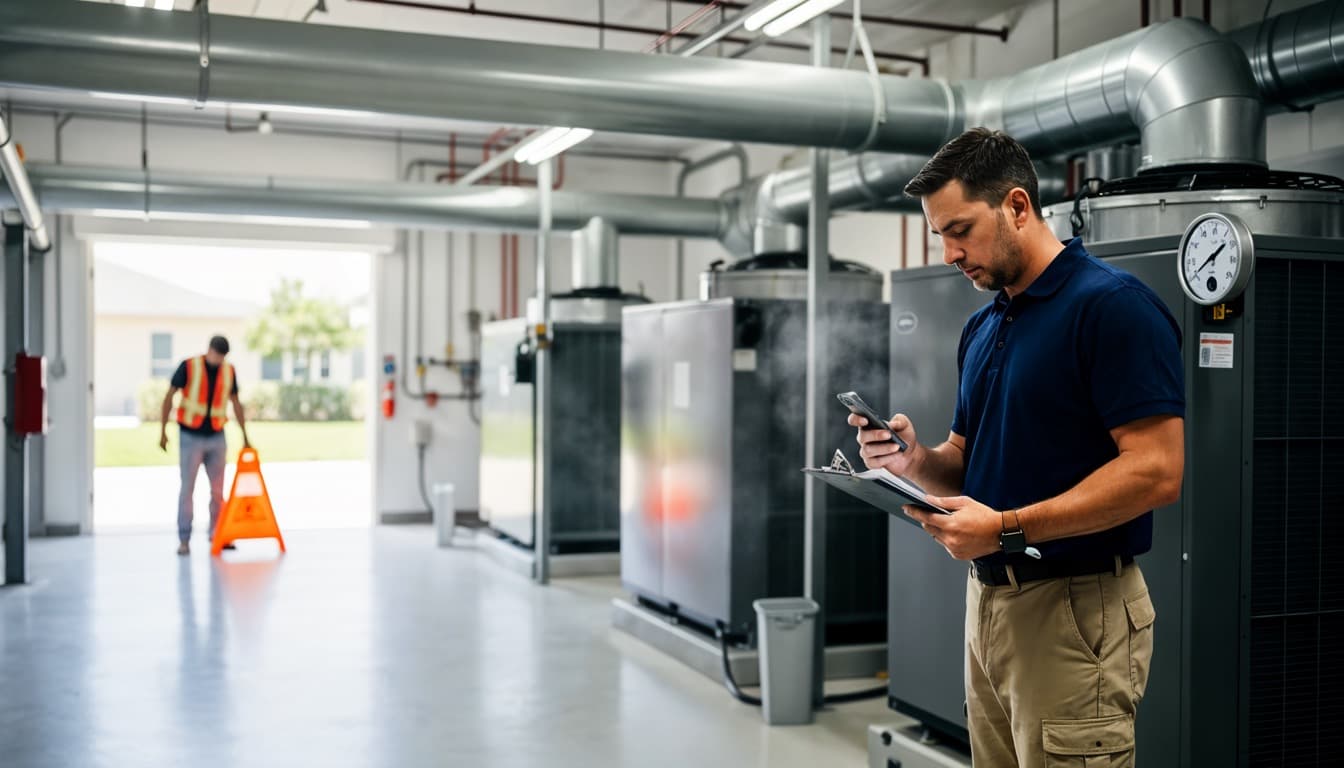
When commercial air conditioning fails in a Florida heat wave, the first half hour matters. It is easy to focus only on the equipment, but a facility manager has a larger job: protect occupants, limit business disruption, preserve useful facts, and get the right service call started. The best response is organized, not improvised.
A rooftop unit, split system, or packaged system can fail for many reasons. A thermostat display, a running blower, or a noisy condenser does not by itself reveal the cause. Keep staff away from electrical and mechanical hazards, do not remove access panels, and avoid a sequence of resets that can obscure the issue or create more damage.
Minutes 0–5: protect people and verify the complaint
First, identify the affected area and who is in it. Check on occupants who may be especially sensitive to heat, including children, older adults, people with medical concerns, and employees doing physical work. Move people to a cooler safe area if that is available. Make water accessible and adjust activities that add heat to the space. Follow your organization’s safety and heat-illness policies; an HVAC service call should not delay an urgent medical response.
Confirm whether the issue is one zone, one system, or the whole building. Ask simple questions: When was the area last comfortable? Are other spaces cooling? Is airflow present? Are there water leaks, unusual odors, smoke, or harsh noises? If there is a burning smell, smoke, exposed wiring, or immediate electrical concern, keep people clear and use the appropriate emergency response before calling for routine HVAC service.
Minutes 5–10: gather safe, useful observations
At the thermostat or building control, record the setpoint, displayed temperature, and any alarm message. Do not make repeated setting changes. A technician needs to know the original condition, not a dozen adjustments made under pressure.
From ground level or a safe accessible area, observe the equipment without opening it. Is an outdoor fan operating? Is there visible ice? Is a drain pan overflowing near the indoor equipment? Has a breaker tripped? Do not reset a breaker repeatedly. A single trip can be a sign of an electrical fault, and repetitive resets can make a hazardous situation worse.
If the facility has a building automation system, save or photograph relevant alarms and trend information according to company policy. Note the time the event began, recent work in the area, a power interruption, construction dust, roof work, or any earlier comfort complaints. Those details can reduce diagnosis time.
Minutes 10–20: stabilize the facility
Reduce heat gain where practical. Close exterior doors, lower shades on sun-facing glass, stop unnecessary heat-producing work, and move meetings or customer activity to cooled spaces. Keep interior doors positioned according to your building’s normal airflow plan; do not prop fire doors or defeat safety systems to chase cooler air.
If a leak is present, protect people from slip hazards and move sensitive equipment or records away from water if it is safe to do so. Do not stand in water near electrical equipment. If the system is frozen or making damaging noise, turn off cooling at the thermostat and tell the service provider what you observed. Do not attempt refrigerant work, wiring repair, or internal cleaning.
For tenant spaces, communicate early. A straightforward message explaining that the issue is being assessed is better than silence. Give staff a point of contact and ask them to report symptoms, not diagnoses. “The west office has weak airflow and is 78 degrees” is useful. “The compressor is bad” is not something a user can reliably conclude.
Minutes 20–30: make a complete service call
Call A/C Advantage or your designated commercial HVAC provider with the equipment location, affected areas, occupant impact, operating symptoms, visible hazards, and site-access details. Have the unit model and serial number available if it is safe and easy to access from your records. Explain whether the equipment is on a roof, behind a locked gate, above a ceiling, or in a space with special access requirements.
Also state whether the system serves a business-critical area such as a server room, medical office, kitchen, classroom, or occupied retail floor. That does not change safe diagnostic practice, but it helps the service team understand operational priorities. If you have recent service records, share the last known issue and repair history.
A commercial HVAC technician should evaluate the system methodically: controls, airflow, electrical components, drainage, coil condition, refrigerant performance, mechanical condition, and the building conditions that affect it. A quick part swap without diagnosis is not a dependable heat-wave plan.
Turn the incident into better preparation
After cooling is restored, document what happened and what delayed response. Was the unit easy to identify? Did the manager have the service number and access instructions? Were filters, drains, and maintenance records current? Repeated comfort complaints, electrical faults, or drainage issues deserve a planned conversation rather than another emergency-only call.
Commercial maintenance helps facility managers see patterns before the hottest week puts them on display. Read our Commercial Rooftop HVAC Guide for the broader planning picture. If your business has a heat-related AC failure or needs a documented maintenance plan for its equipment, contact A/C Advantage for commercial HVAC diagnostics and service. We will focus on the actual operating condition and a practical path back to reliable comfort.
About the author
Scott Camire, Owner of A/C Advantage Inc.
Scott Camire is the founder of A/C Advantage Inc. in Port St. Lucie, Florida. He began his career in HVAC and commercial refrigeration in 1978 and founded A/C Advantage in 2006, building the company on what he calls “old fashioned service with modern technology.” A/C Advantage is a Florida Certified Mechanical Contractor (License #CMC1249807) with EPA-certified technicians, serving homes and businesses across the Treasure Coast and the Palm Beaches, including Port St. Lucie, Stuart, Palm City, Jensen Beach, Fort Pierce, Vero Beach, Sebastian, and Tradition.
Need help with your system?
Call A/C Advantage at (772) 336-7366. A live person answers 24 hours a day, 365 days a year. Or schedule service online.